.webp)
Because inspection data only matters if it can support decisions that hold up

Bridge programs don’t struggle because they lack bridge inspection data. They struggle because their data doesn’t consistently translate into decisions that hold up under scrutiny. Across most agencies, bridge inspection cycles are well-established, standards are followed, and data collection is not the problem. Yet when it comes time to prioritize projects, justify funding, or explain trade-offs, the process often becomes more manual than it should be. Not because the data is missing, but because the path from inspection to decision is not fully connected. Somewhere between the field and the funding table, context is lost, assumptions are introduced, and consistency becomes harder to maintain.

That gap is where most programs feel the pressure today. And it is exactly where the role of bridge data is changing.
Bridge inspection data follows defined formats such as NBI ratings and element-level quantities, including component condition ratings and element-level condition states defined under current standards. It captures condition, extent, and supporting notes. This creates a strong baseline, but it does not directly define what action should be taken. Before it can support downstream analysis, this data often requires cleansing to address inconsistencies, incomplete entries, and variations introduced during collection.

A condition rating or an element state does not translate into a clear intervention on its own. It requires interpretation based on extent of deterioration, location, structural role, and expected performance of possible treatments.
Variability begins here. Different inspectors may interpret thresholds differently. Critical context may exist in notes or images that are not consistently carried forward.
Systems like inspectX™ improve consistency at the point of capture by enforcing required inputs, aligning inspectors with coding guidance, supporting offline field workflows, and validating entries in real time. More importantly, they retain the relationship between condition, quantities, and supporting documentation so that data can be used without rework. This reduces the need for reinterpretation later in the process.
The most important step in the data journey is converting bridge inspection data into defined work actions. Bridge programs operate on decisions, not condition ratings. The question is not only what condition exists, but what should be done in response.

This step is often handled through engineering judgment supported by spreadsheets and past experience. While effective, it can lead to inconsistency across the network.
In manageX™, inspection data is directly linked to work actions through configurable rules. Element quantities and condition states are used to recommend preservation, repair, rehabilitation, or replacement strategies based on agency-defined thresholds.
At this stage, the level of precision in the underlying data becomes critical. Small differences in quantities or condition distribution can influence the type and scale of intervention selected. manageX™ retains data at a granular, decimal level, allowing agencies to evaluate deterioration and quantities with greater accuracy rather than relying on rounded or generalized values.
This creates a consistent framework for translating condition into action while still allowing engineers to review and adjust recommendations.
The result is a clearer and more repeatable path from inspection to intervention.
Once work actions are defined, the focus shifts from current condition to future performance.
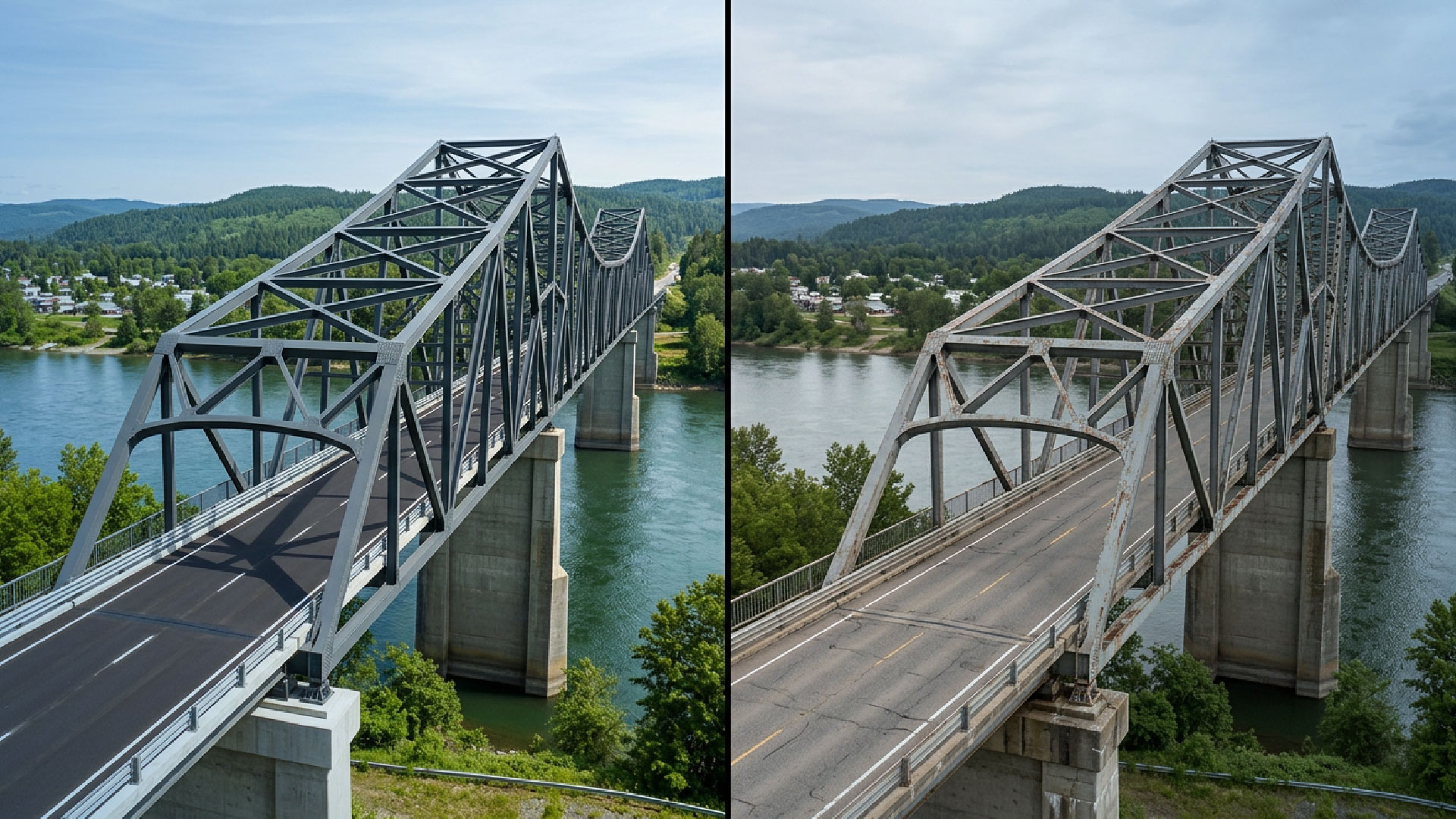
Bridge programs manage long-term asset behavior under uncertain funding conditions. This requires understanding how assets will deteriorate over time and how different interventions will affect that trajectory.
In manageX™, inspection data feeds into deterioration models aligned with established bridge management practices. These models project future condition states and allow agencies to evaluate how the network will perform under different strategies.
This supports questions such as:
This step converts inspection data into program-level insight.
Funding constraints require agencies to make trade-offs. The challenge is not identifying needs but selecting which actions to take within limited budgets.
manageX™ supports scenario analysis where agencies can evaluate different funding levels, treatment strategies, and performance targets.

Each scenario is based on bridge inspection data, defined work actions, cost assumptions, and projected deterioration. This allows agencies to compare outcomes in terms of condition distribution, backlog, and performance measures.
Equally important is the ability to revisit and refine these scenarios. As assumptions change, funding levels shift, or new inspection data becomes available, agencies can rerun scenarios without rebuilding the analysis from scratch. This allows agencies to compare outcomes in terms of condition distribution, backlog, performance measures, and the long-term cost implications of different strategies.
Prioritization becomes a structured process based on measurable impact rather than isolated project evaluation.
By the time projects are presented for funding, decisions must be consistent, data-driven, and defensible.

A selected project should be traceable back to:
This ensures that funding decisions are not only defensible but also grounded in long-term performance and lifecycle cost considerations. The traceability allows agencies to clearly explain why a project is prioritized, what outcome it supports, and what risks are associated with delaying it.
Without this connection, decisions become harder to justify and more dependent on manual explanation.
Most agencies have the necessary components in place. Inspection programs are established. Engineering expertise is strong. Management systems are available. The issue is the connection between these components. When data is reinterpreted across systems, context is lost, or analysis relies on manual consolidation, the process becomes less reliable. A connected workflow ensures that data moves from inspection to decision without loss of structure or meaning.
When inspection systems like inspectX™ align with management platforms like manageX™, the transition from field data to program decisions becomes more direct.
Inspection data flows forward without duplication. Work actions are derived using consistent rules. Performance modeling reflects current and validated conditions. Funding scenarios are based on actual network data. This reduces delays and improves confidence in decision-making.
Bridge inspection data is not valuable because it is collected. It is valuable because it can support decisions that are clear, consistent, and defensible. From field inspection to funding allocation, each step must maintain the integrity of that data. When the process is connected, decisions are supported by evidence. When it is not, decisions rely on interpretation. For agencies managing large networks under limited budgets, that difference defines how effectively resources are allocated.
Ready to transform your operations? Schedule a consultation today and unlock the full potential of your asset management capabilities with our innovative solutions.