
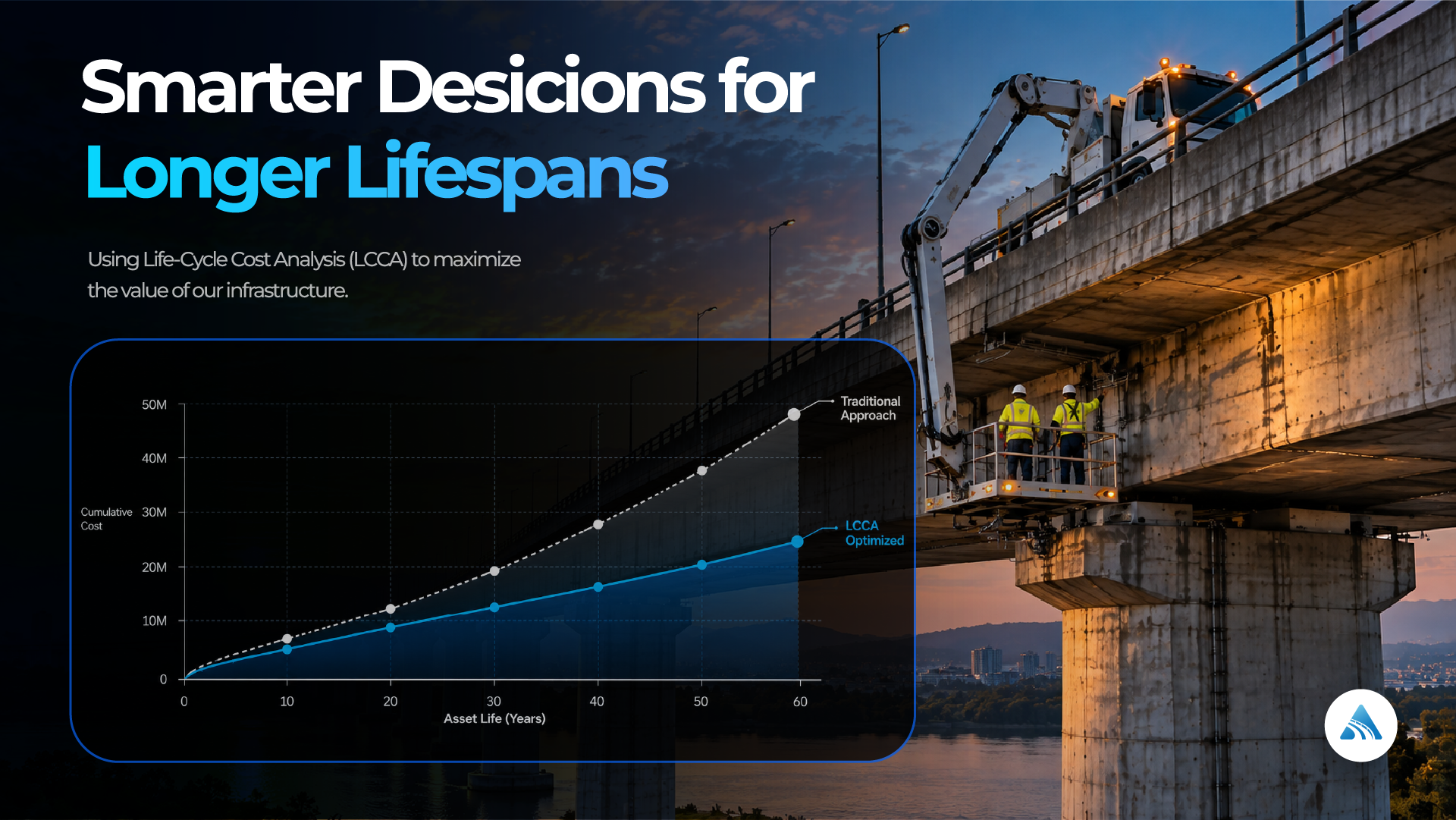
A bridge may be designed and constructed in a matter of years, but the financial commitment to that bridge can extend for decades.
The initial construction cost is only the first major expenditure in an asset's life. After opening, the bridge requires inspection, maintenance, preservation, rehabilitation, and eventually major renewal or replacement. The timing, frequency, and scale of those interventions can vary significantly based on condition, deterioration, environment, treatment strategy, and operational requirements.
For transportation agencies managing large bridge inventories, this creates a more important question than simply asking what a project costs today:
What will this asset cost to own, preserve, and ultimately renew over its life?
Life-Cycle Cost Analysis (LCCA) provides a structured way to answer that question.
Rather than evaluating an investment based only on its initial price, LCCA compares alternative strategies over a defined analysis period and brings future expenditures into present-value terms. It allows agencies to examine not just what they spend, but when they spend it and what that spending means over the life of the asset.
For bridge infrastructure, that shift is significant. It moves the conversation from the cost of delivering a project to the economics of managing an asset.
Consider two strategies for the same bridge.
The first requires relatively little expenditure in the early years but leads to a major rehabilitation later. The second requires a larger intervention earlier, potentially extending service life and changing the timing of subsequent work.
Looking only at today's expenditure, the first option may appear more economical.
Looking across the asset's life, the conclusion may be very different.
This is the fundamental problem LCCA addresses. FHWA describes LCCA as an engineering economic analysis used to compare alternative investment options by considering initial and discounted future agency and, where applicable, user costs over the life of the project or asset.
The key word is alternative.
LCCA is not simply an exercise in estimating everything a bridge might cost over time. It is a structured comparison of reasonable strategies that achieve the required objective.
That means the analysis begins by defining the alternatives, identifying the activities each alternative requires, estimating when those activities will occur, and assigning costs to them.
Only then does the economic comparison begin.
And that leads to the first important principle of LCCA:
Life-cycle cost is determined not just by how much an intervention costs, but by how the entire sequence of interventions unfolds over time.
At its core, LCCA converts a series of costs occurring at different points in time into a common economic basis.
A simplified formulation is:
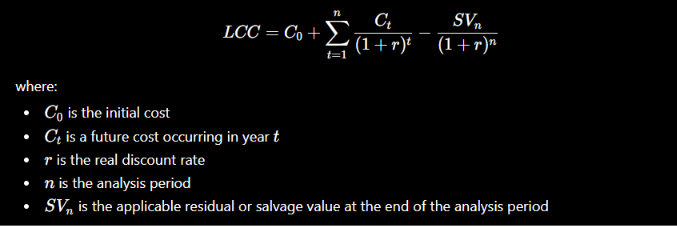
The mathematics are relatively straightforward.
The analytical challenge lies in determining what costs enter the equation, when they occur, and how confidently those assumptions can be made.
For a bridge, the cost stream may include routine maintenance, preservation treatments, rehabilitation, major component work, and eventual replacement. Depending on the purpose and methodology of the analysis, user costs associated with traffic disruption or other impacts may also be relevant.
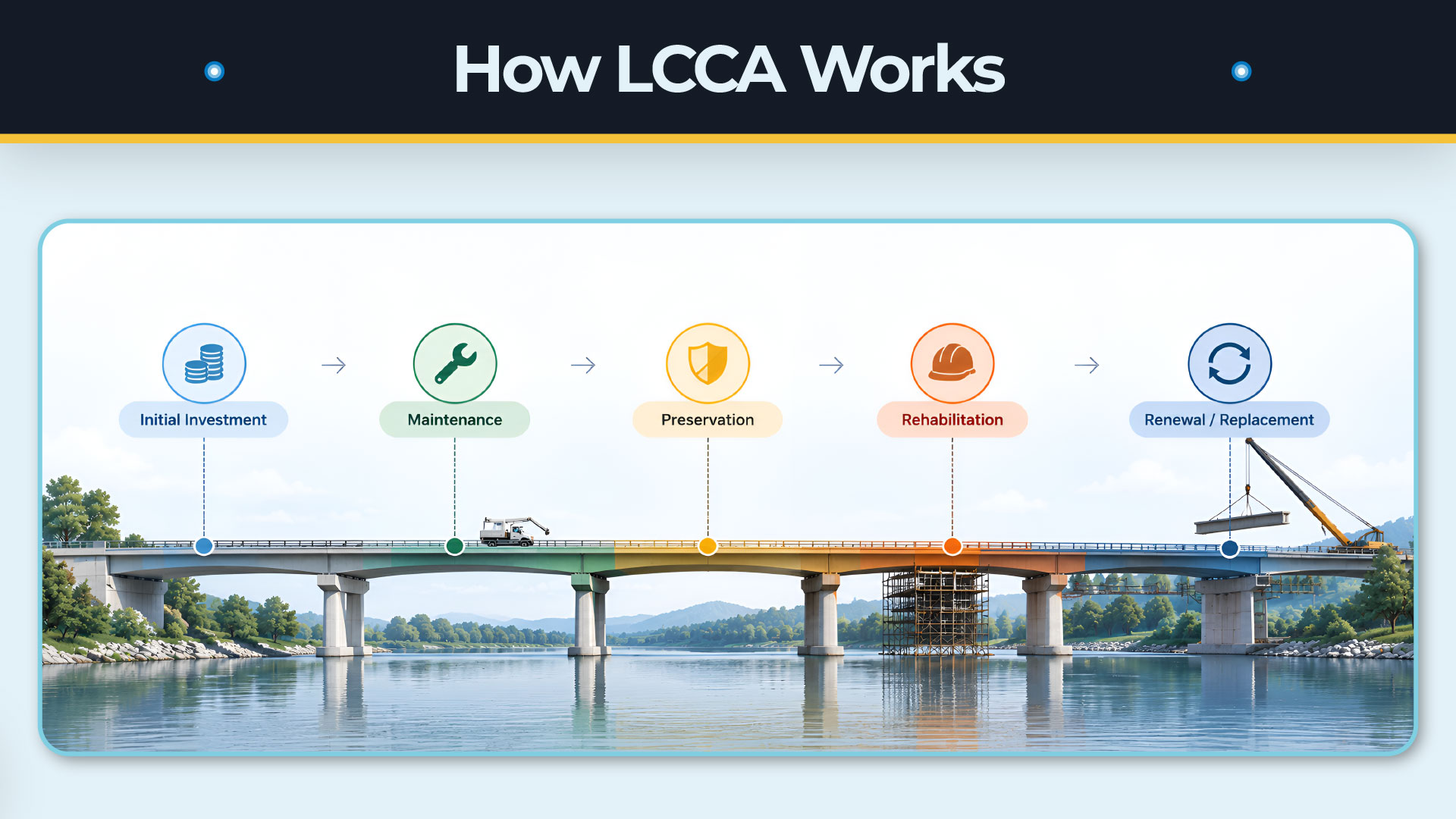
FHWA's LCCA framework follows this same logic: establish alternatives, determine activity timing, estimate agency costs, estimate applicable user costs, and determine life-cycle cost.
The calculation therefore does not stand on its own.
The future cost stream is the model.
And because the future cost stream is time-dependent, intervention timing becomes one of the most important variables in the analysis.
A $5 million rehabilitation occurring ten years from now is not economically equivalent to a $5 million rehabilitation occurring thirty years from now.
The nominal expenditure is the same. Its present value is not.
The basic present-value relationship is:

As the expenditure moves further into the future, its present value changes according to the discount rate.
But this does not mean that agencies should simply defer work for as long as possible.
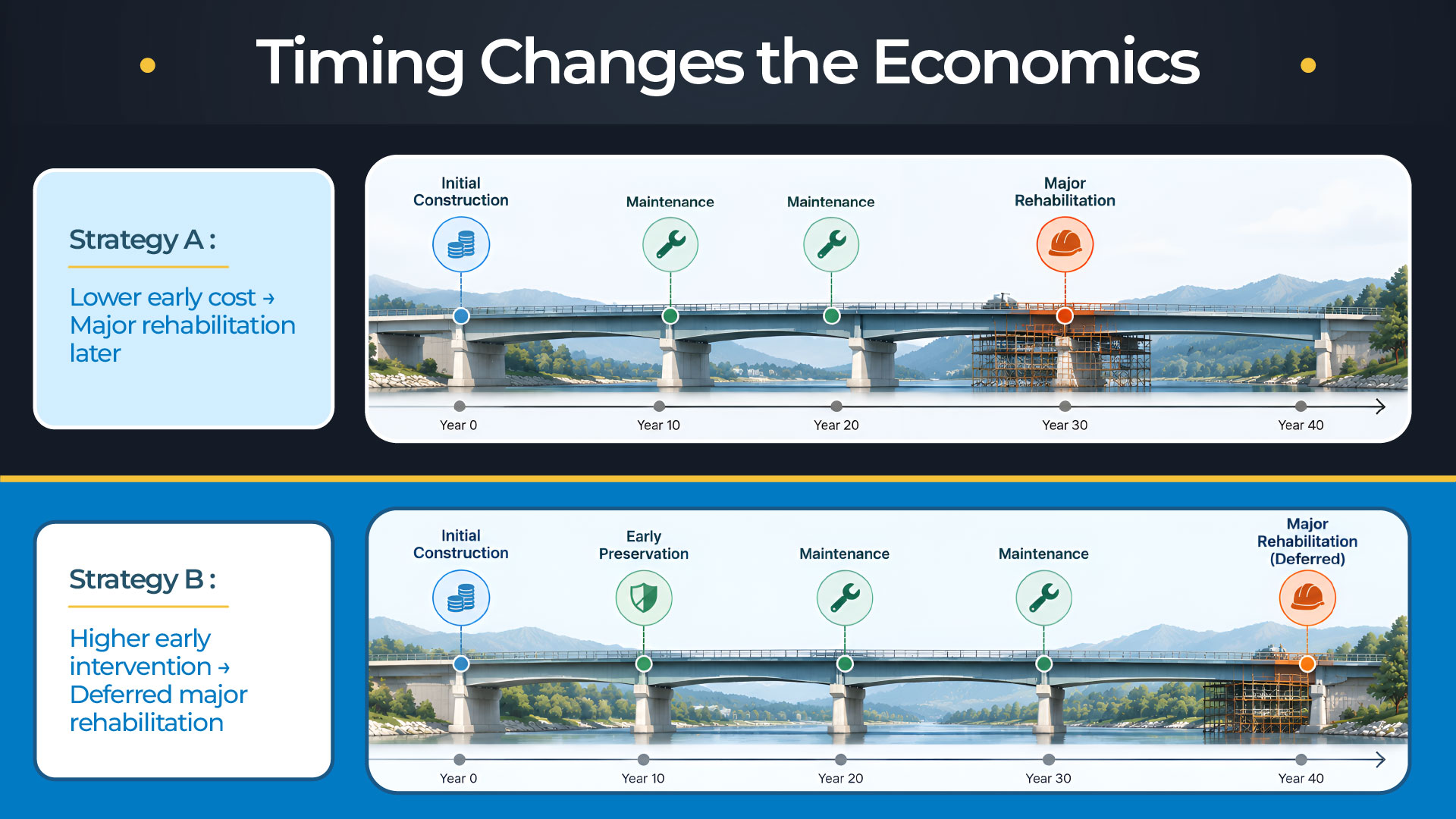
Deferring intervention may reduce its present-value contribution to the LCCA while allowing deterioration to continue. That could result in a more expensive rehabilitation later, greater disruption to users, or a different overall service-life outcome.
Conversely, an earlier preservation treatment may require additional expenditure today while extending service life and postponing a larger future intervention.
This is why LCCA is fundamentally about strategies over time.
The question is not simply:
Which treatment costs less?
It is:
Which intervention strategy produces the most favorable life-cycle cost for the required outcome?
That distinction becomes especially important when agencies evaluate several plausible futures for the same bridge.
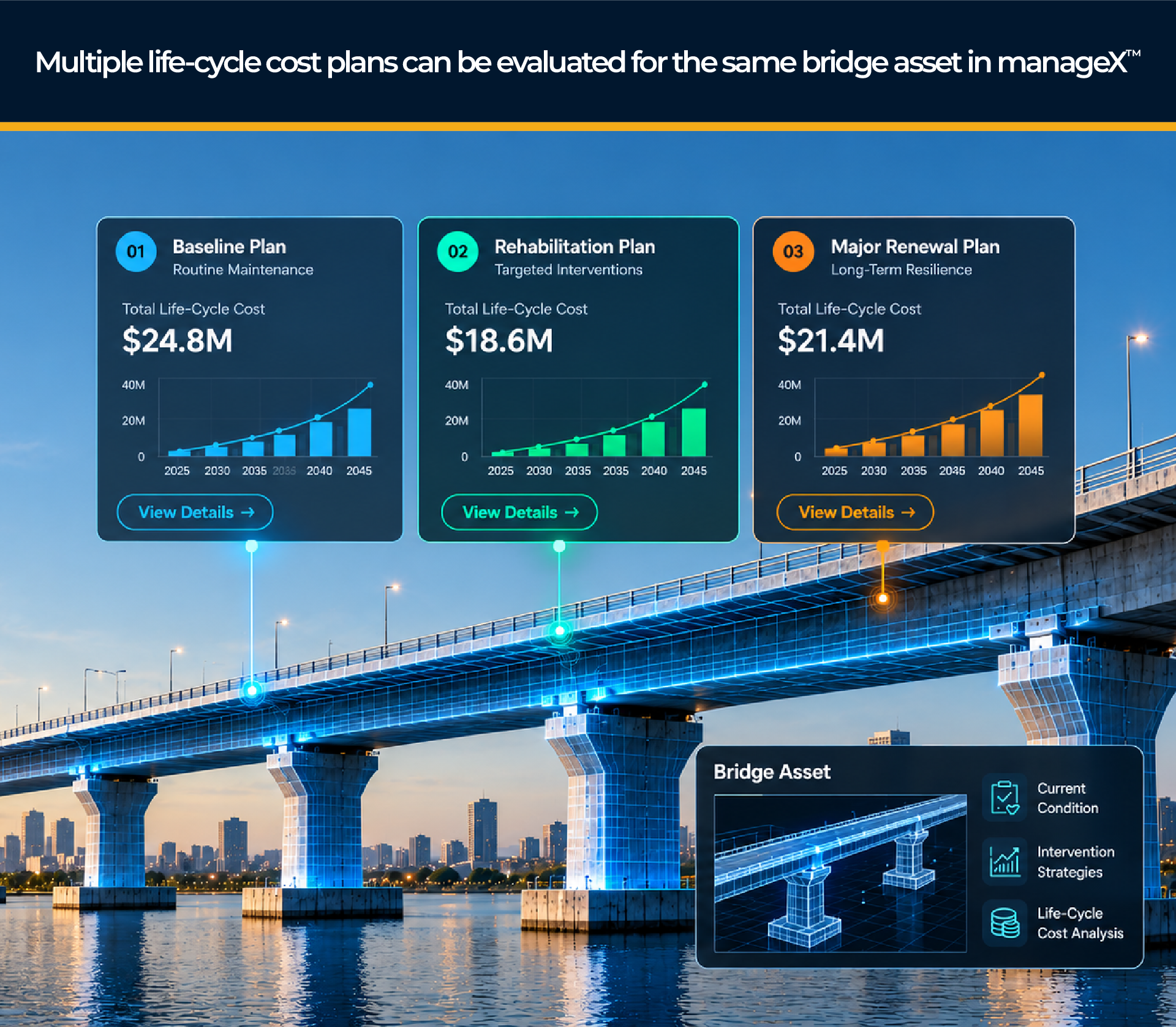
Imagine a bridge for which an agency is evaluating three approaches.
Plan A takes a lower-intervention approach, continuing routine maintenance before a major rehabilitation is required.
Plan B introduces an earlier preservation treatment, increasing near-term expenditure but potentially delaying major rehabilitation.
Plan C makes a larger intervention earlier in the asset's life, changing the subsequent sequence of maintenance and rehabilitation activities.
Each plan creates a different cost stream.
Each has a different timing of expenditure.
And each may produce a different total life-cycle cost after discounting.
This is precisely where an asset-level LCCA environment becomes useful.
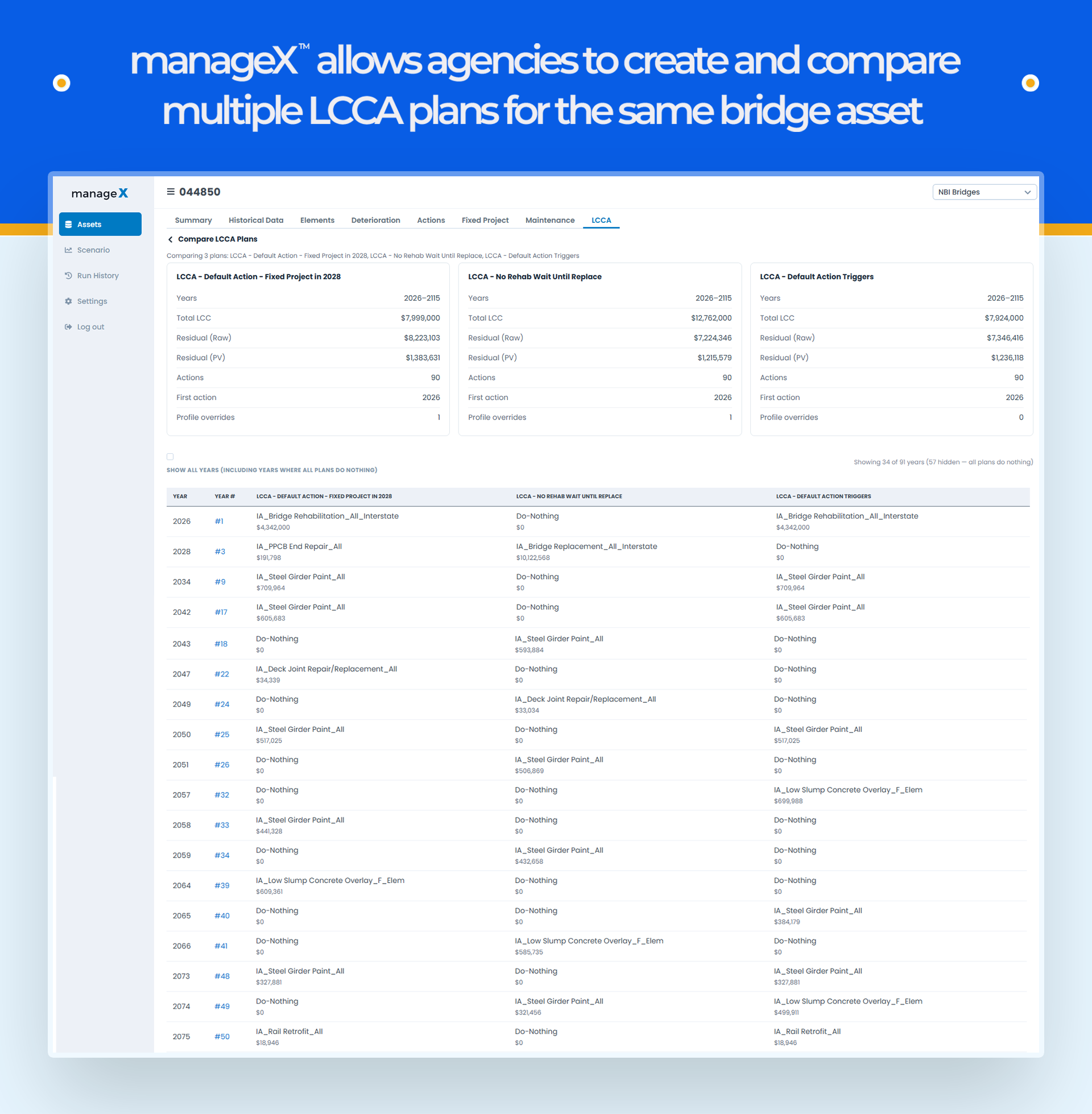
In manageX™, multiple LCCA plans can be created for the same bridge and compared side by side. Rather than treating each scenario as an isolated calculation, agencies can represent different cost strategies against the same bridge asset and examine their resulting total LCC.
The significance is not simply that multiple calculations can be performed.
It is that the alternatives remain connected to the asset for which the decision is being made.
That connection becomes increasingly important as the analysis horizon is defined.
Every LCCA needs an analysis period.
The analysis period establishes the window over which alternatives are evaluated and therefore determines which future activities enter the comparison.
If the period is too short, important differences between strategies may fall outside the analysis window. A strategy requiring significant rehabilitation shortly after the end of the analysis period could appear artificially attractive because those costs are not fully represented.
FHWA guidance emphasizes using a common analysis period for competing alternatives and selecting a period long enough to capture meaningful differences in future activities and service life.
For bridge infrastructure, this is particularly important because preservation strategies can have very different temporal profiles.
One plan may require a significant intervention early and little major work afterward. Another may defer expenditure but require a larger intervention later. A third may extend service life beyond the original analysis horizon.
In manageX™, Start Year and Analysis Length are defined as part of each LCCA plan, allowing the analysis horizon to be explicitly represented alongside the alternative being evaluated.
This makes the analysis period more than a hidden parameter.
It becomes part of the documented economic scenario.
And once costs are distributed across that period, they need to be economically comparable.
That is the role of the discount rate.
LCCA generally uses real costs with a real discount rate, following the methodology adopted by the agency and applicable guidance. The purpose is to express costs occurring in different years in comparable present-value terms.
The discount rate matters because it influences how future expenditures are weighted relative to current expenditures.
A higher rate reduces the present value of distant costs more rapidly. A lower rate gives future costs greater weight.
There is therefore no universal discount rate that should simply be inserted into every analysis. Agencies should use the applicable methodology and document the assumptions used.
This is also why economic assumptions need to be visible.
manageX™ provides LCCA settings where real discount-rate profiles can be configured by year, with the option to apply a common rate across years. This allows the discounting assumptions to be represented explicitly within the LCCA rather than remaining buried in an external spreadsheet or calculation.
The important point is not that software can perform discounting.
The mathematics are well established.
The value comes from making the economic assumptions part of the asset-level analysis and comparison.
A useful LCCA needs to capture the costs relevant to the alternatives being compared.
For bridge infrastructure, these can include:
Construction, rehabilitation, or other expenditure required to implement the alternative.
Recurring activities required to maintain the bridge and its components.
Interventions intended to slow deterioration, maintain condition, or extend useful life.
Larger interventions required when routine maintenance or preservation is no longer sufficient.
The eventual major expenditure associated with replacing or substantially renewing the asset.
Intervention-related impacts experienced by transportation users, such as delay, vehicle operating costs, detours, or other disruption-related effects.
The applicable remaining value at the end of the analysis period.
The exact composition depends on the alternatives, the purpose of the analysis, and the agency's methodology. Not every LCCA will treat every cost category in exactly the same way.
What matters is that the cost boundary is clearly defined and applied consistently across the alternatives.
The end of the analysis period introduces another important consideration.
An asset does not necessarily become economically worthless simply because the LCCA stops at a particular year.
For example, an intervention performed shortly before the end of a 30-year analysis period may still have substantial remaining service life beyond Year 30. If that remaining value is ignored, the comparison can be distorted.
Residual or salvage value provides a way to account for applicable remaining value according to the methodology being used.
manageX™ allows the salvage-value methodology to be configured within its LCCA settings, including a Minimum GCR-Based option in the current implementation as the default method.
The specific methodology selected should follow the agency's adopted approach.
Again, the important capability is not simply having a salvage-value setting.
It is having the methodology explicitly represented as part of the LCCA assumptions for the asset and its plans.
That makes it easier to understand not only the resulting number, but also how that number was produced.
At this point, another issue becomes unavoidable.
An LCCA can be mathematically correct and still produce a weak decision if the assumptions feeding it are poor.
Future intervention timing cannot be selected intelligently without understanding the asset.
For a bridge, that understanding can include:
FHWA's asset-management guidance recognizes that expected activities, timing, and costs can be informed by bridge management systems, inspection reports, historical information, and asset-manager expertise.
This creates an important relationship:
The LCCA model does not exist independently of the bridge.
The bridge provides the context from which many of the assumptions are developed.
This is one of the strongest reasons to bring LCCA closer to the asset-management workflow.
Instead of treating the economic analysis as a separate exercise performed after asset information has been collected, agencies can connect the economic question to the asset being evaluated.
That is the point at which LCCA begins to become an asset-management capability rather than simply an economic calculation.
The future of a bridge cannot be known with perfect certainty.
An intervention expected in Year 15 may be needed earlier or later. A rehabilitation estimated at one cost may ultimately cost more or less. A treatment expected to provide a certain service life may perform differently under actual conditions.
This means an LCCA result should not be interpreted as a prediction with false precision.
A deterministic analysis uses defined values for inputs and produces a corresponding life-cycle cost. Sensitivity analysis can then test how the result changes when important assumptions are varied.
For example:
Probabilistic LCCA goes further by representing uncertain inputs through probability distributions and evaluating a range of possible outcomes. FHWA recognizes both deterministic and probabilistic approaches within LCCA practice.
The purpose is not to make the analysis unnecessarily complex.
It is to understand how robust the economic conclusion is.
That distinction matters when comparing alternatives whose calculated life-cycle costs may be relatively close.
A difference of a few percentage points means something very different when the result is highly sensitive to one uncertain assumption than when it remains stable across a broad range of assumptions.
This is where manageX™'s Plan-based Approach becomes particularly relevant.
If a bridge can have several plausible intervention strategies, the agency needs a practical way to represent those alternatives.
manageX™'s LCCA capability allows multiple plans to be created for the same bridge and evaluated side by side.
Each plan defines a start year, analysis length and applicable profile overrides. manageX then calculates the total life-cycle cost for comparison.
This provides a structured way to represent different economic futures for the same asset.
The agency can therefore move from a single question:
"What is this bridge's life-cycle cost?"
To a more useful set of questions:
"What is the life-cycle cost under each intervention strategy?"
"How does changing the timing of work affect the result?"
"Which plan produces the more favorable economic outcome?"
"How much of that conclusion depends on the assumptions?"
That is a substantially stronger decision framework.
The bridge remains the common reference point, while the LCCA plans represent alternative ways of managing its future.
An LCCA result is only as transparent as the assumptions supporting it.
manageX™ brings several of those assumptions into the LCCA configuration itself.
Real discount-rate profiles can be configured by year, including the ability to use a common rate across years.
Salvage-value methodology can be configured according to the approach being applied, including the Minimum GCR-Based option available as default.
Profile overrides can be captured within individual LCCA plans, allowing plan-specific assumptions to be represented where required.
Together with the defined start year and analysis length, these settings make the structure of an LCCA plan visible.
That matters because public-sector infrastructure decisions need to be explainable.
A life-cycle cost figure without its assumptions is difficult to interpret.
A life-cycle cost figure associated with a defined analysis period, discount-rate set, salvage value methodology, and alternative treatment and deterioration plans provides a much clearer decision record.
In addition to having a powerful LCCA platform, it is important to reduce the separation between the economic analysis and the asset-management decision.
In manageX™, the LCCA capability sits within the bridge asset itself.
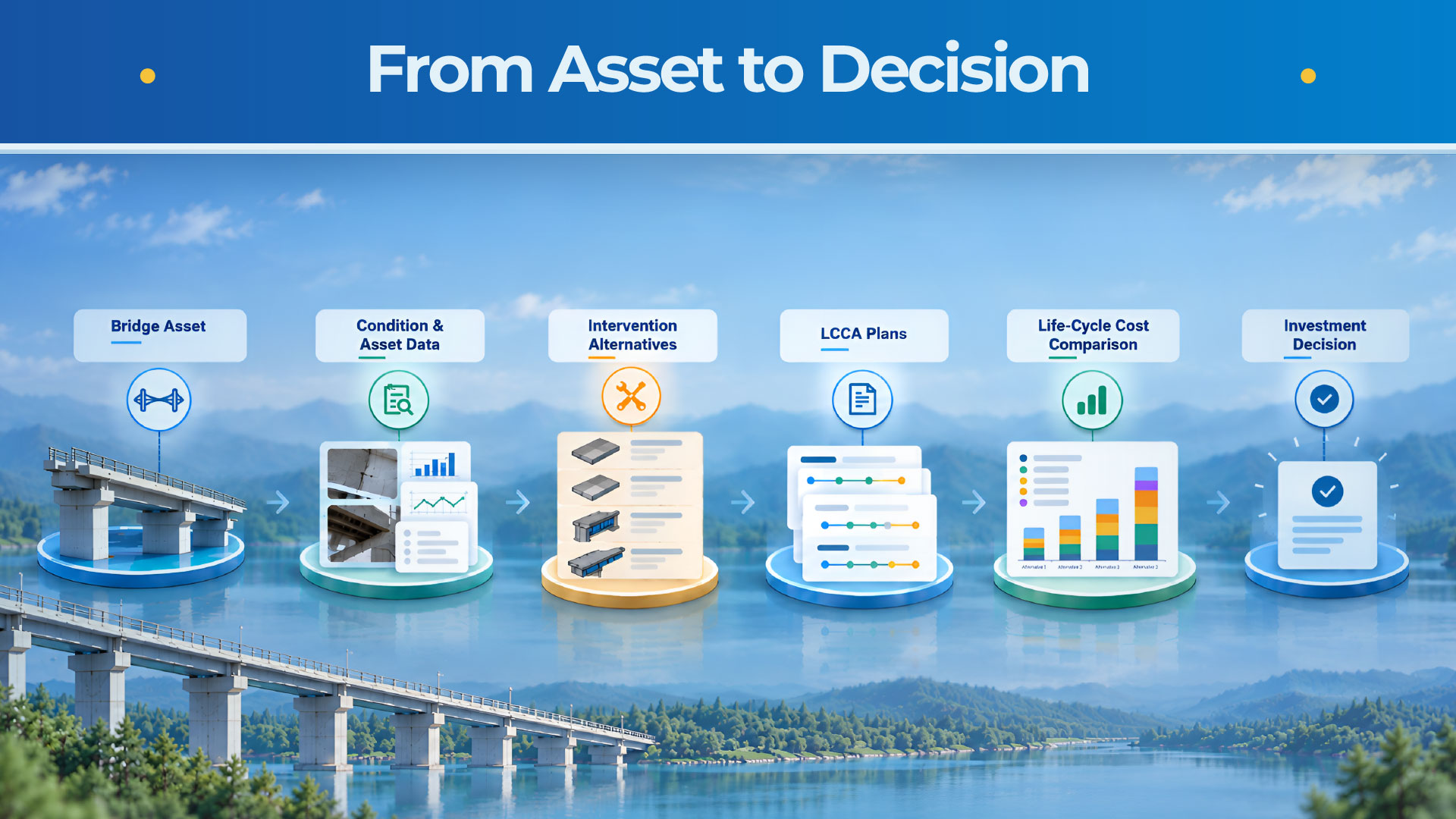
That creates a workflow in which:
Bridge asset
→ Asset condition and information
→ Potential intervention strategies
→ LCCA plans
→ Cost and timing assumptions
→ Discounted life-cycle cost
→ Side-by-Side comparison
→ Investment decision
The benefit is contextual continuity.
The LCCA is no longer just a number produced somewhere outside the asset record.
It becomes part of the information used to understand how the asset could be managed over time.
There is one important boundary.
LCCA should not be confused with network-level asset management or life-cycle planning.
LCCA is generally concerned with project- or asset-level economic comparison.
Broader life-cycle planning operates at the network level, considering multiple assets, funding constraints, performance objectives, treatment strategies, and competing investment needs.
For example, an LCCA may show that Strategy B is the lowest-cost strategy for a particular bridge.
That does not automatically mean that bridge should receive funding before every other bridge in the inventory.
The network-level decision still has to consider:
This distinction is important because LCCA should inform asset-management decisions without being positioned as a substitute for them.
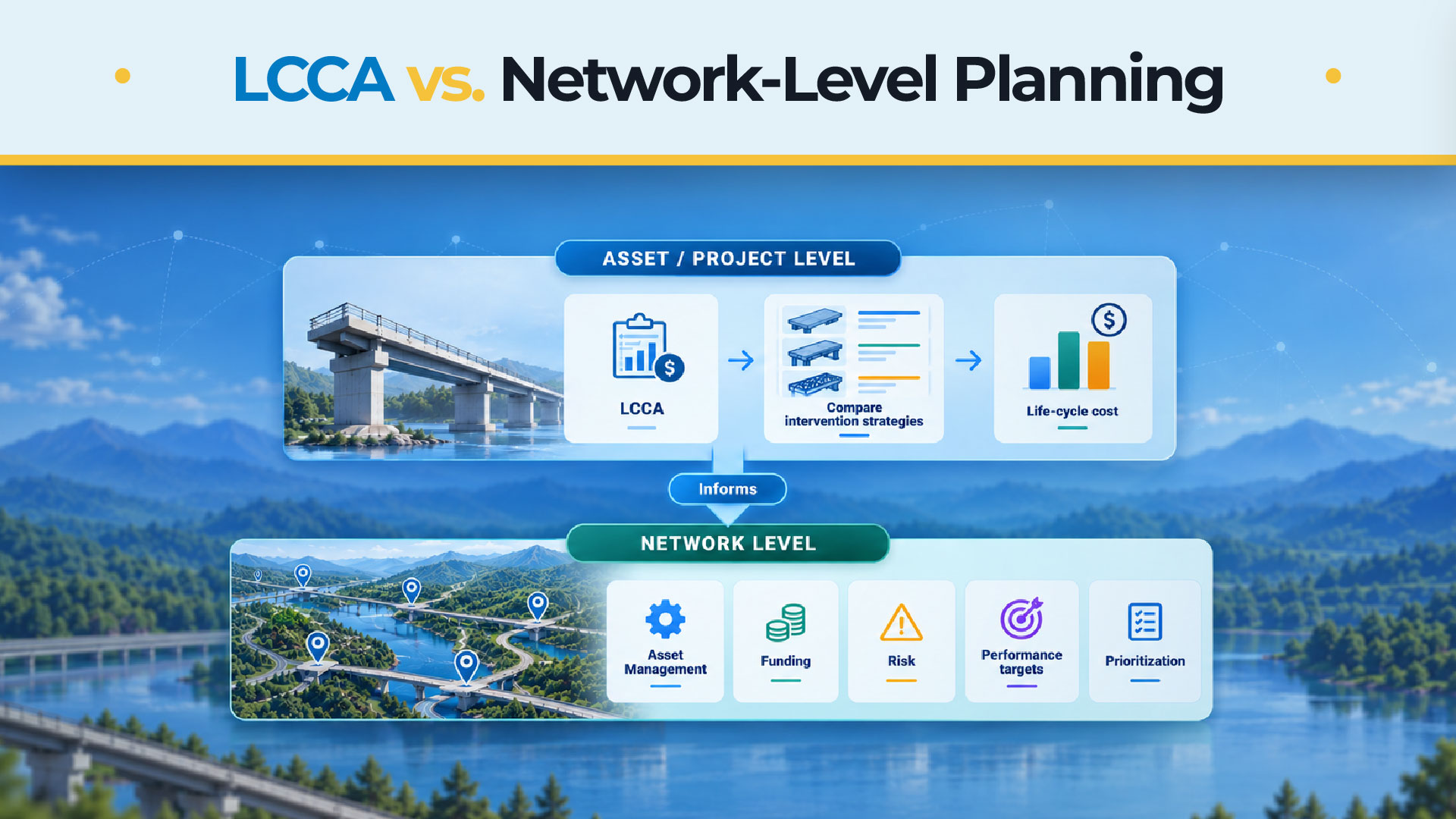
LCCA answers an economic question about an alternative. Asset management determines how those alternatives fit into the broader investment strategy.
manageX™'s value lies in bringing the LCCA closer to that broader asset-management environment.
A bridge does not remain static.
New inspection information can change the understanding of its condition. A completed preservation activity can remove a previously expected expenditure. Faster deterioration can move an intervention earlier. Changing cost assumptions can alter the relative economics of two strategies.
FHWA guidance recognizes that LCCA should be revisited when significant inputs such as costs, discount rates, scope, traffic assumptions, or other conditions change.
That leads to an important way of thinking about asset-level LCCA:
The analysis should remain connected to the information that drives its assumptions.
This does not mean continuously recalculating an LCCA for every minor change.
It means recognizing that a life-cycle cost conclusion is conditional on the asset information and assumptions available when it is developed.
When those inputs materially change, the economic comparison may need to change as well.
An asset-integrated environment makes that relationship easier to maintain because the analysis and the asset are not completely separated.
A bridge may have one initial construction cost, but it can generate decades of maintenance requirements, preservation decisions, rehabilitation needs, operational impacts, and eventual renewal costs.
That is why infrastructure investment decisions cannot stop at the initial price.
Life-Cycle Cost Analysis provides the economic framework for looking beyond that first expenditure. It brings future costs into present-value terms, makes intervention timing part of the comparison, accounts for applicable user and residual costs, and provides a structured way to evaluate competing strategies.
But the quality of that analysis depends on more than the equation.
It depends on the alternatives being modeled, the timing assigned to future activities, the economic assumptions used, the uncertainty surrounding those assumptions, and the quality of the asset information supporting them.
This is where integrating LCCA into bridge asset management becomes valuable.
With manageX™, LCCA is positioned within the bridge asset itself, where agencies can create multiple cost plans and deterioration profiles, define analysis horizons, configure economic assumptions, and compare alternative life-cycle costs side by side.
The result is not a new form of LCCA.
It is a more connected way to apply an established methodology.
The shift is from asking what a bridge costs to build, to understanding what it costs to own. From evaluating a single expenditure to evaluating a strategy. And from treating LCCA as a standalone calculation to making it part of the long-term decision record for the asset.
For agencies responsible for preserving public infrastructure, that is ultimately the more meaningful measure of cost: not simply what is spent today, but the value created by making better decisions across the life of the asset.
Interested in exploring how manageX™ can support life-cycle cost analysis for your bridge assets?
Ready to transform your operations? Schedule a consultation today and unlock the full potential of your asset management capabilities with our innovative solutions.