.webp)

For years, infrastructure management has relied on a rhythm built around routine: scheduled inspections, annual reporting cycles, and a predictable flow of data moving from the field to the office. That rhythm has changed. Inspections today produce far more information than ever before. Standards such as SNBI demand deeper detail. Emergency events increase the urgency for quick, accurate assessments. And the volume of digital evidence, history, and context keeps rising. This shift hasn’t replaced the human element, but it has outgrown the old ways of handling information. That’s where AI in infrastructure management fits in - not as a replacement, but as a steady support system that helps agencies keep pace with modern demands.
The role of AI in public infrastructure is often misunderstood. It isn’t here to make structural decisions or override expertise. It exists to take on the cognitive load that has become unmanageable: sorting, checking, organizing, validating, surfacing. Infrastructure data has grown too fast and too wide to navigate manually. Moving from reactive management toward proactive, data-driven decision support requires systems that can keep the work clean, consistent, and accessible.
Agencies across the country are beginning to recognize that AI-driven infrastructure management isn’t disruptive; it’s simply necessary.
A single bridge inspection can generate hundreds of photos, videos, notes, sketches, measurements, and SNBI fields. Multiply that across a network, and reviewers are handling some of the largest data volumes they’ve ever seen. Emergency events add another layer of complexity: scattered evidence, rapid assessments, and compressed timelines.
Maintenance crews contribute logs, citizen reports add new alerts, and historic data stretches across multiple formats.
AI proves its value here. It can process this growing volume of inputs quickly, organizing them in ways that make sense to engineers and reviewers. It can clean up irregularities that slow teams down. And it can classify the right information, so decision-makers spend their time analyzing, not searching.
The work remains human; AI simply keeps the information manageable. This is exactly where AI in infrastructure management proves indispensable, giving teams a clearer, more organized view of everything they capture in the field.

Photos and documents remain one of the biggest manual burdens in inspection programs. AI can recognize components, group related evidence, tag likely defects, and bring structure to what is usually a massive folder filled with unsorted media. Reviewers no longer start from a blank slate; they begin from a workspace already organized for them - a key advantage in AI-driven infrastructure management.

AI can highlight potential observations: a crack pattern, a corrosion spot, an alignment shift. It doesn’t “rate” the defect or decide its severity, that remains strictly in the inspector’s hands. But having a second set of eyes helps reduce oversight, especially in large inspections where small details are easy to miss.
Review cycles often slow down because reviewers spend more time verifying data integrity than evaluating structural context. AI can flag a mismatched value, a missing reference, or a detail that doesn’t align with historic entries. It becomes the system’s built-in quality assistant - not replacing judgment but sharpening it, which is one of the most tangible benefits of AI in infrastructure management today.
Transitioning to SNBI requires structured, complete, and consistent datasets. AI can map fields across systems, surface inconsistencies before submission, and reduce the hours spent cross-checking every attribute manually. Teams benefit from cleaner data with less friction,a major step toward stronger infrastructure lifecycle management with AI.

When a bridge hit or incident occurs, the chaos of multimedia evidence can delay analysis. AI can immediately classify images, detect vehicle types, and organize impact-related visuals so engineers can begin assessing the situation without waiting for files to be sorted. It’s speed without cutting corners.
The connection between AI and safer infrastructure isn’t theoretical. When teams access the right information faster, decisions become clearer. When review cycles stay consistent, the chance of missing a detail decreases. When datasets align correctly, maintenance prioritization becomes sharper. AI helps eliminate the noise so agencies can focus on what matters. It ensures field teams stay aligned with standards, reviewers begin with cleaner inputs, and emergency teams move with confidence in compressed timeframes. Infrastructure management becomes more resilient because the information behind every decision is more dependable.Infrastructure management becomes more resilient because the information behind every decision is more dependable - a core advantage of AI in infrastructure management done right.
The real maturity in using AI for infrastructure management comes from knowing exactly where its limits should be. AI is powerful when it handles information, patterns, and repetitive checks, but it has no place as the final authority on structural conditions or safety.
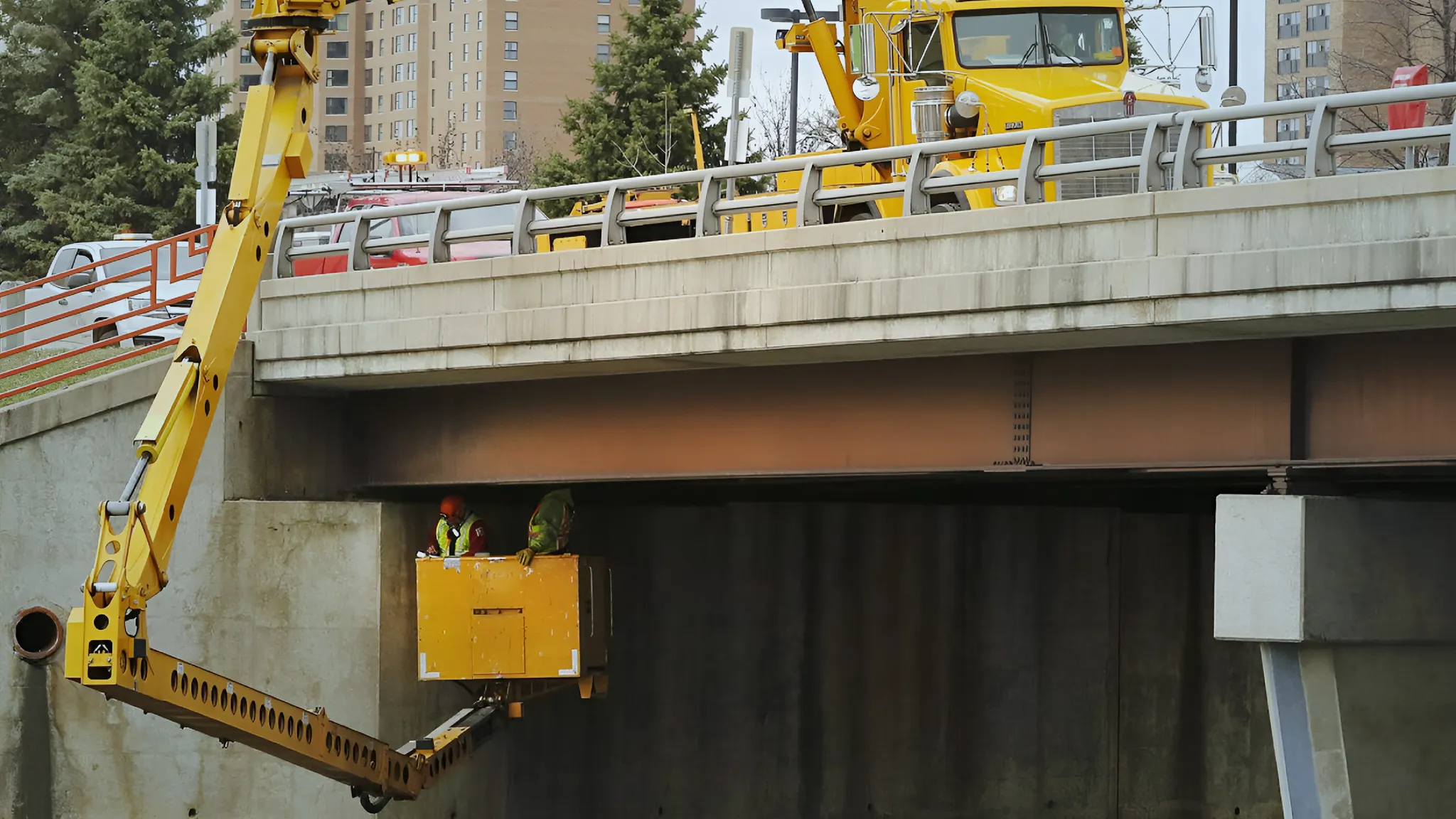
AI can identify patterns in photos, but it can’t stand under a bridge and understand the story behind a defect - how it formed, what context sits behind it, or what subtle cues the inspector sees in the field. It can flag an unusual value in a deck rating, but it can’t determine whether that deck is safe to carry live traffic. It can suggest that a note looks incomplete, but it cannot interpret the engineering judgment that explains why an element behaves differently this cycle compared to the last.
For example, an AI model may detect a crack in a girder photo and classify it as “notable,” but only an experienced inspector can determine whether that crack is superficial surface checking or a sign of deeper fatigue. AI may see two inspection entries that look inconsistent, but it cannot understand that one entry reflects a design nuance unique to a specific structure. And during emergencies, AI might sort evidence quickly, but it cannot evaluate structural vulnerability or predict whether a closure is necessary.
These decisions rely on intuition shaped over years, the kind of tacit knowledge that comes from walking structures, observing real-world behavior, and understanding local environments. That’s why AI should never replace the human role in rating, assessing, or declaring safety. Its job is to guide, prompt, and support - not decide.
Agencies that adopt AI with this philosophy end up with the strongest workflows:
AI handles the load. Humans make the call.
As with any evolving capability, agencies must approach AI with clarity. Data quality matters: legacy systems sometimes need updates to fully benefit. Staff need the time and training to adapt. Privacy and auditability remain critical, especially for public infrastructure, and these considerations are central to how AI in infrastructure management should be adopted.
This is why purpose-built platforms, designed specifically for public agencies, matter. Systems like inspectX™ from AssetIntel™ evolve with these realities in mind, adding intelligence only where it genuinely helps - supporting true AI-driven infrastructure management.
AI is becoming a standard companion in the tools agencies use every day - as normal as GIS maps or tablet-based fieldwork. It will strengthen collaboration across offices, field teams, maintenance groups, and emergency units by reducing friction in information flow. Agencies will gradually shift from raw data collection to actual intelligence, supported by systems that give clarity instead of complexity.
As AI in infrastructure management becomes more routine, human oversight remains the core of all decisions. AI simply becomes the mechanism that ensures nothing is lost, missed, or overlooked.

This is also where the industry is beginning to explore conversational tools - assistants that help clarify standards, point out inconsistencies, and guide inspectors during detailed workflows. AssetIntel™ is already advancing in this direction with its upcoming Q&A Chatbot, an inspection-focused companion designed to support SNBI compliance, reduce rework, and give teams on-demand guidance without interrupting their flow. It’s subtle, practical, and built to make the daily work lighter - exactly how smart infrastructure using AI should function.
AI’s role in infrastructure isn’t to reshape the work - it’s to support it. It helps agencies move faster, respond with more clarity, and manage rising data demands without compromising accuracy or safety. When inspectors, engineers, and reviewers are backed by systems that keep information clean and consistent, communities benefit from safer assets and stronger daily operations.
This is the future of infrastructure management: human expertise supported by intelligent tools that stay in the background and make the work smoother. And as platforms like inspectX™ and upcoming capabilities such as the AssetIntel™ Q&A Chatbot continue to evolve, agencies will have even more ways to streamline inspections, strengthen reviews, and stay aligned with modern standards.
If your team is looking to bring this level of clarity and support into your workflows, we’re here to help you get started.
Ready to transform your operations? Schedule a consultation today and unlock the full potential of your asset management capabilities with our innovative solutions.